

Canada Startup Funding : Canada’s AI sector closed May 2026 with two landmark capital events that together directed over $86 million USD into the ecosystem in a single month. Government policy and private venture capital moved in the same direction, with compute access and open-source AI infrastructure emerging as the defining investment themes. This roundup covers every confirmed AI funding round in Canada during May 2026, with verified dates, raise amounts, lead investors, and direct source links.
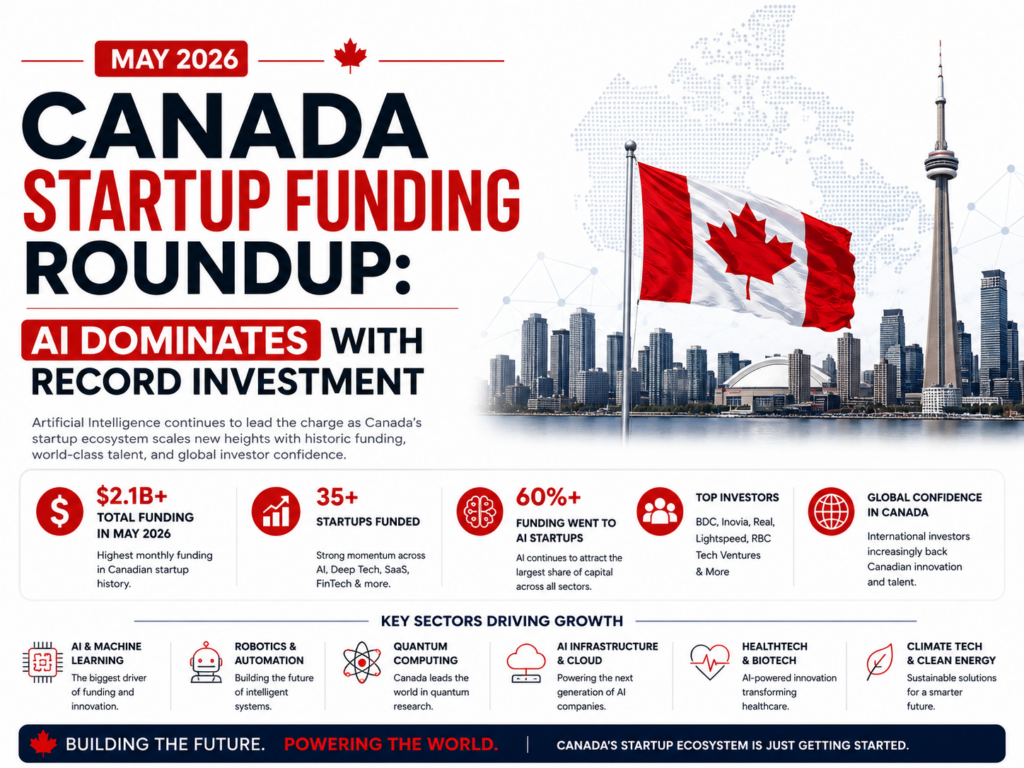
TABLE OF CONTENTS
- Canada AI Funding Overview: May 2026
- Featherless AI Raises $20M Series A (April 30, 2026)
- Canada AI Compute Access Fund: $66M for 44 SMEs (May 12, 2026)
- What These Rounds Signal for the Canadian AI Ecosystem
- Canada AI Funding Stats: 2026 Year to Date
- FAQ: Canada AI Startup Funding May 2026
Canada AI Funding Overview: May 2026
May 2026 confirmed the direction Canada’s AI sector has been taking all year: capital is concentrating around infrastructure and access rather than individual applications. The two headline events of the month were Featherless AI’s $20M Series A for open-source model infrastructure and the federal government’s first deployment of its $300M AI Compute Access Fund, worth $66M across 44 businesses. Combined, these two events pushed over $86M into AI in a single month, reinforcing Canada’s standing as one of the top five AI startup hubs globally.
Through May 2026, Canadian startups had raised $2.22B across 144 equity funding rounds, tracking slightly below the same period in 2025 but heavily skewed toward larger, fewer deals. AI remained the dominant sector, accounting for a disproportionate share of the country’s total venture activity.
Featherless AI Raises $20M Series A
Date: April 30, 2026 Raise: $20M USD Stage: Series A Lead Investors: AMD Ventures, Airbus Ventures Participating Investors: BMW i Ventures, Kickstart Ventures, Panache Ventures, Wavemaker Ventures Total Funding to Date: $25M USD Source: BetaKit | Tech Funding News
Canadian co-founder Wesley George and CEO Eugene Cheah built Featherless to solve a structural problem in how developers access open-source AI models. The platform currently supports over 30,000 open models hosted on Hugging Face across language, vision, audio, and multimodal use cases, all accessible through a single API without requiring teams to manage their own infrastructure.
The Series A was co-led by AMD Ventures, the investment arm of Advanced Micro Devices, and Airbus Ventures, making it one of the more strategically significant rounds of the year. AMD’s participation signals direct hardware ecosystem interest in open-source inference infrastructure, a bet that enterprise AI will diversify well beyond a handful of dominant foundation model providers.
George, who previously co-founded Toronto-based Proof Data Technology before its acquisition in 2022, framed the company’s mission clearly: the AI stack is too concentrated, too expensive for smaller teams, and too dependent on a small number of US hyperscalers. Featherless charges a flat monthly rate between $10 and $75 for unlimited token usage, positioning itself as four to ten times cheaper than per-token providers at production scale.
The company’s founding team spans Canada, Singapore, and Australia, with offices in San Francisco, Toronto, Singapore, and across Europe. Infrastructure is hosted across the US and EU to meet sovereign AI and data privacy requirements for enterprise customers.
The $20M will fund global infrastructure expansion, a dedicated marketplace for specialized open models, and deeper hardware integration, including AMD’s ROCm platform.
Direct source: https://betakit.com/canadian-co-founded-featherless-ai-secures-20-million-usd-to-build-open-source-ai-infrastructure/
Canada AI Compute Access Fund: $66M for 44 SMEs
Date: May 12, 2026 Fund Amount Deployed: $66M USD (first tranche of $300M total fund) Announced by: Evan Solomon, Minister of Artificial Intelligence and Digital Innovation Location of Announcement: Web Summit Vancouver 2026 Source: BetaKit | Canada.ca
The federal government’s first deployment from the AI Compute Access Fund reached 44 Canadian small and medium enterprises on May 12, 2026, announced at Web Summit Vancouver by AI minister Evan Solomon. The program offers financial support specifically to subsidize the cost of compute, covering 67 cents on the dollar for companies using Canadian cloud infrastructure and 50 cents for those using foreign compute providers.
Compute has become the central bottleneck in Canada’s AI commercialization pipeline. For most Canadian SMEs, the cost of training or scaling AI models on GPU infrastructure is prohibitive without direct subsidy. The AI Compute Access Fund directly targets that barrier, giving companies the runway to commercialize or scale AI projects that would otherwise stall at the model development stage.
The $66M deployed in May represents the first tranche of a broader $300M program. Further tranches are expected throughout 2026, with eligibility extended to SMEs across every province working on AI commercialization, product development, or infrastructure scaling.
This is one of the clearest signals yet that Ottawa is treating AI compute as national infrastructure, comparable to how previous governments treated broadband or industrial energy access.
What These Rounds Signal for the Canadian AI Ecosystem
Two themes defined Canada’s AI funding in May 2026.
The first is infrastructure neutrality. Featherless AI’s round, backed by AMD rather than a software-focused VC, reflects growing investor conviction that the most durable AI businesses will sit below the model layer. Whoever controls inference infrastructure for open models controls a critical choke point in the next phase of AI adoption.
The second is government as co-investor. Canada now has a dedicated AI minister, a $300M compute fund, and a framework that explicitly rewards companies for using Canadian infrastructure. This is a structural shift. The government is not just funding research. It is subsidizing commercialization, which accelerates time to revenue for early-stage AI companies in a way that grants and tax credits alone cannot.
Both trends point toward a Canadian AI ecosystem that is maturing beyond the research prestige of Mila, Vector Institute, and the Amii network, toward deployable, revenue-generating AI businesses with real infrastructure under them.
Canada AI Funding Stats: 2026 Year to Date
Total raised in Canada (Jan to May 2026): $2.22B across 144 equity rounds Largest single raise in Canadian history: Waabi $1B (January 28, 2026) AI sector share of total Canadian VC: approximately 30% through mid-2025, tracking higher in 2026 Number of AI companies in Canada: 998, of which 304 are funded Cumulative AI sector funding in Canada (10 years): $11.3B Peak year for Canadian AI funding: 2025 at $2.41B
FAQ: Canada AI Startup Funding May 2026
Q: What was the biggest AI funding round in Canada in May 2026?
A: The two headline events were Featherless AI’s $20M Series A (April 30, 2026) and the federal government’s $66M deployment through the AI Compute Access Fund on May 12, 2026.
Q: Who is Featherless AI and why does it matter for Canada?
A: Featherless AI is an open-source AI infrastructure platform co-founded by Canadian Wesley George. The company gives developers and enterprises access to over 30,000 open-source AI models through a single API. Its $20M Series A was co-led by AMD Ventures and Airbus Ventures and is one of the largest Canadian AI infrastructure raises of early 2026.
Q: What is Canada’s AI Compute Access Fund?
A: It is a $300M federal program designed to subsidize compute costs for Canadian SMEs working on AI commercialization. The first tranche of $66M was announced on May 12, 2026 at Web Summit Vancouver, supporting 44 businesses. Companies using Canadian cloud infrastructure receive 67 cents on the dollar; those using foreign compute receive 50 cents.
Q: How much has Canada raised in AI funding in 2026?
A: Through May 2026, Canadian AI companies raised approximately $932M in equity funding across 10 rounds. Total Canadian startup funding across all sectors reached $2.22B across 144 rounds in the same period.
Q: Is Canada a top destination for AI investment in 2026?
A: Yes. Canada ranks among the top five global AI startup hubs, with clusters in Toronto, Montreal, and Vancouver linked to world-class research institutions including Mila, the Vector Institute, and the University of Waterloo. In 2025, AI accounted for approximately 30% of all Canadian venture capital deployed.
🔎 Discover more top Canadian startups across every sector at: https://beststartup.ca/


